
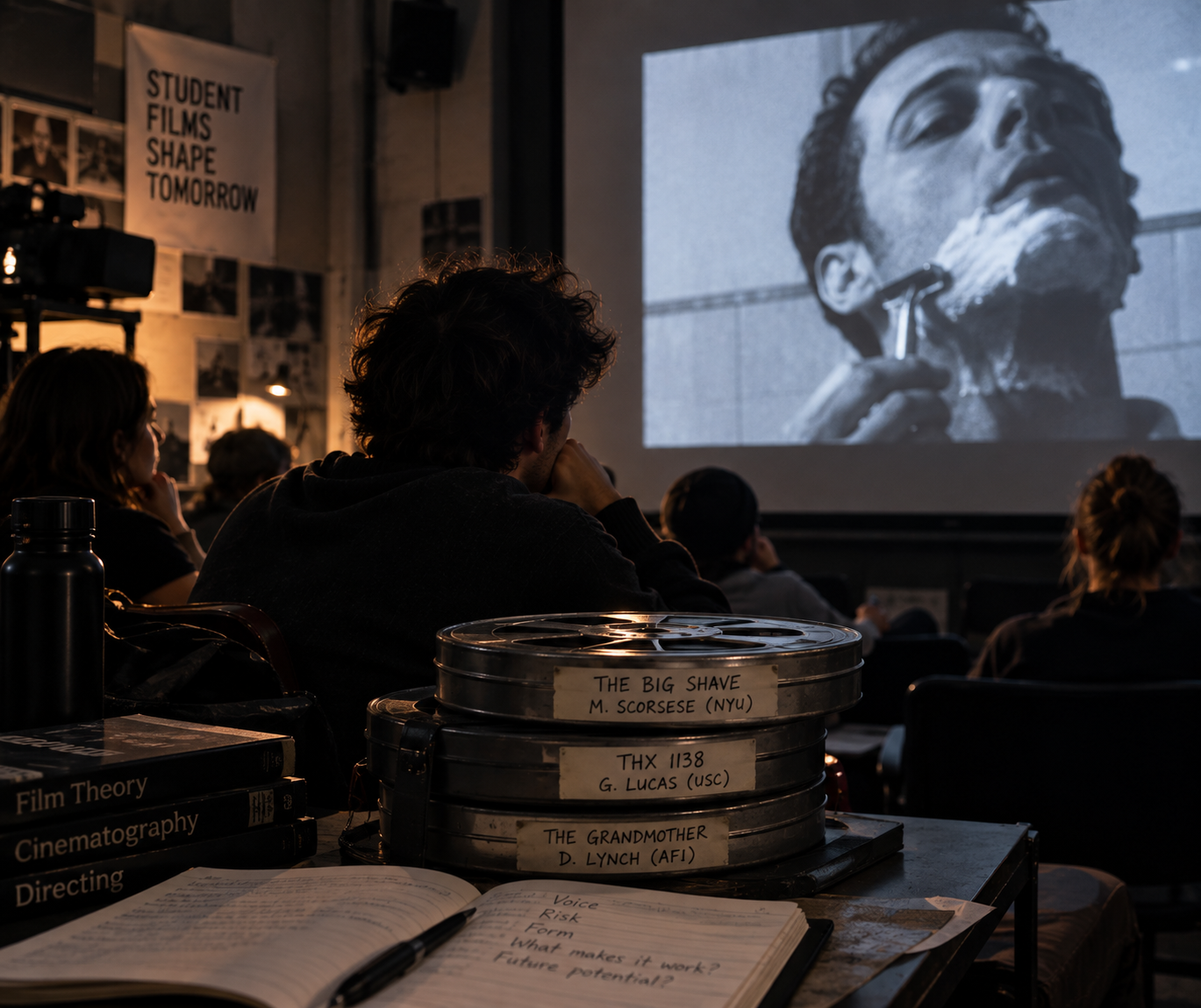
A student film can be rough at the edges, slightly overstuffed, or made with a budget that barely covers catering. It can also contain the first unmistakable sign of a major screen voice. That is why the best films from film schools are worth more than a nostalgic look at famous careers. They show what happens when filmmakers are still taking big swings, before market logic starts sanding down the strange, specific ideas.
For viewers who want work that feels less processed, film school archives and graduate showcases are a serious source of discovery. For emerging creators, they are a reminder that a short does not need permission to be ambitious. It needs a point of view, a clear emotional charge and the craft to carry it.
What makes a film school film worth watching?
The strongest student work does not look polished simply for the sake of it. It makes a deliberate choice. A camera position creates unease. A sound cut turns an ordinary room into a threat. An animation style becomes part of the story rather than decoration. Even when resources are limited, intent is visible.
That is the real test. The best films from film schools do not try to imitate a studio feature scene for scene. They use constraints as part of the form. One location can create pressure. A small cast can sharpen a character conflict. An imperfect visual effect can become memorable when it serves a distinctive world.
There is a trade-off, of course. Not every daring school film is fully resolved, and not every technically impressive graduate project has something urgent to say. The work that lasts tends to bring both elements together: control of the medium and a reason to use it.
Landmark films that began in the classroom
These films are not a definitive ranking. They are useful entry points because each carries the energy that makes early work exciting: an artist testing a language before anyone has told them to play it safe.
The Big Shave - Martin Scorsese, New York University
At six minutes, The Big Shave is concise, controlled and deeply unsettling. The premise is simple: a man shaves in a bright bathroom until the ritual becomes self-destruction. Its clean composition and escalating violence show how editing, repetition and tone can make a short film land with real force.
The lesson for creators is not to make work shocking for its own sake. It is to commit to an idea. Scorsese takes one image, pushes it without flinching and leaves the audience to sit with the result.
Electronic Labyrinth: THX 1138 4EB - George Lucas, University of Southern California
This early version of THX 1138 is a compact piece of speculative cinema built from sterile spaces, coded dialogue and an oppressive atmosphere. It does not explain every detail of its world. Instead, it trusts sound, production design and fragmentation to make control feel palpable.
That trust matters. Emerging filmmakers are often told to clarify everything. Sometimes clarity is essential; sometimes mystery creates the stronger experience. This film shows how withholding information can pull a viewer deeper into a world, provided the mood and internal logic are strong enough.
The Grandmother - David Lynch, American Film Institute
The Grandmother is an unnerving collision of live action, animation and nightmare logic. A lonely boy grows a grandmother from a seed, and the film moves according to emotional association rather than familiar plot mechanics. It is strange because it needs to be strange.
Its value lies in that refusal to become conventional. The film’s handmade textures and abrupt shifts are not flaws to smooth away. They are the expression. For anyone making experimental work, it is a useful reminder that consistency of feeling can matter more than conventional realism.
Peel - Jane Campion, Australian Film Television and Radio School
Jane Campion’s Peel turns a family car trip into a small, sharp study of irritation, cruelty and shifting power. The setup is ordinary, but the observation is not. Campion finds tension in gestures, glances and petty behaviour, proving that a cinematic moment does not require a grand premise.
For Australian filmmakers in particular, Peel remains a strong example of how local detail can travel. It does not perform universality. It becomes universal by being exact about people, place and discomfort.
Peluca - Jared Hess, Brigham Young University
Before Napoleon Dynamite, there was Peluca, a short built around awkward social encounters, deadpan delivery and a character who seems slightly out of step with every room he enters. The visual approach is plainspoken, but the comic perspective is already fully present.
Comedy is often treated as easier because it can look casual. It is not. A pause that runs half a beat too long can flatten a joke; a costume or location detail can establish an entire character. Peluca works because its choices are precise without showing off.
More - Mark Osborne, California Institute of the Arts
Made using stop-motion animation, More imagines a grey, mechanised society and the inventor whose creation changes it. Its expressive handmade design gives the story a melancholy that would be weaker in a cleaner, more generic visual style.
Animation students can take a clear lesson from this: technique is storytelling. Material, movement, scale and texture all communicate before a character speaks. A visual concept becomes powerful when every craft choice supports the same emotional world.
Kiwi! - Dony Permedi, School of Visual Arts
Kiwi! is remembered for a single determined character chasing an impossible dream: a flightless bird trying to experience flying. The premise is instantly legible, but the emotional outcome is far less simple. In just a few minutes, it sets up a desire, makes us understand it and follows it to its unsettling end.
That economy is difficult to achieve. A short needs to arrive quickly, but it should not feel rushed. Kiwi! is a useful study in visual setup and payoff, especially for filmmakers working with little or no dialogue.
How to watch emerging work with better instincts
Watching student films as a talent scout is different from watching them as a strict assessor. Do not ask only whether every transition is perfect. Ask what cannot be mistaken for anyone else’s work. Is there an image that stays with you? Does the director understand rhythm? Is the film alive to its characters, or is it merely demonstrating technique?
Pay attention to the choices that reveal future potential. A director may not yet have full command of performance, but their framing could be unusually confident. An animator may be working with simple tools, yet have a rare sense of timing. A writer may overreach structurally while still creating dialogue that feels observed rather than manufactured.
It also helps to look beyond narrative shorts. Music videos, documentary exercises, hybrid work and animated experiments often reveal a creator’s visual intelligence sooner than a conventional drama does. The next distinctive voice may be working in a form that does not fit neat genre labels.
Why these early films matter now
The pathway from film school to an audience has changed, but the need for discovery has not. A graduate film might once have screened mainly in classrooms, small festivals or circulated on a hard drive between friends. Now creators can find viewers more directly, yet the volume of available work makes genuine curation more valuable, not less.
That is where a discovery-first platform has a role. FilmDeck is being built for work with a point of view: the short film, music video, animation or first project that might not fit a conventional catalogue but deserves an audience willing to meet it halfway. For viewers, that means a better chance of seeing the spark before it becomes familiar. For filmmakers, it means their work can be encountered as work, not just as a calling card.
The films that stay with us are rarely those that guessed the market perfectly. They are the ones that made a choice, took a risk and gave us a perspective no one else could have made. Keep watching for that first spark. It is often already there, flickering in a student film made with more nerve than money.
— The FilmDeck Editorial Team